Survey: One In Five Would Use AI To Help With Their Romantic Relationships

Key Findings
- The typical card-and-gift budget this Valentine’s Day is $121, with couples' overall spending exceeding $18.8 billion in 2026.
- Over 152 million Valentine’s Day cards will be purchased, and 6.3 million will be delivered via the USPS.
- Over two in five people have forgotten to buy a card or gift for a partner, either this year or in the past.
- More than a third of people said they have or would use AI to help them pick a gift and/or card for their partner.
- One in five people believe AI could help their relationship, with improved communication as the leading benefit they see from using AI.
- More than one in six people have or would break up with their partner if they found their partner using AI-generated advice in their relationship.
What are people spending and sending on Valentine’s Day?
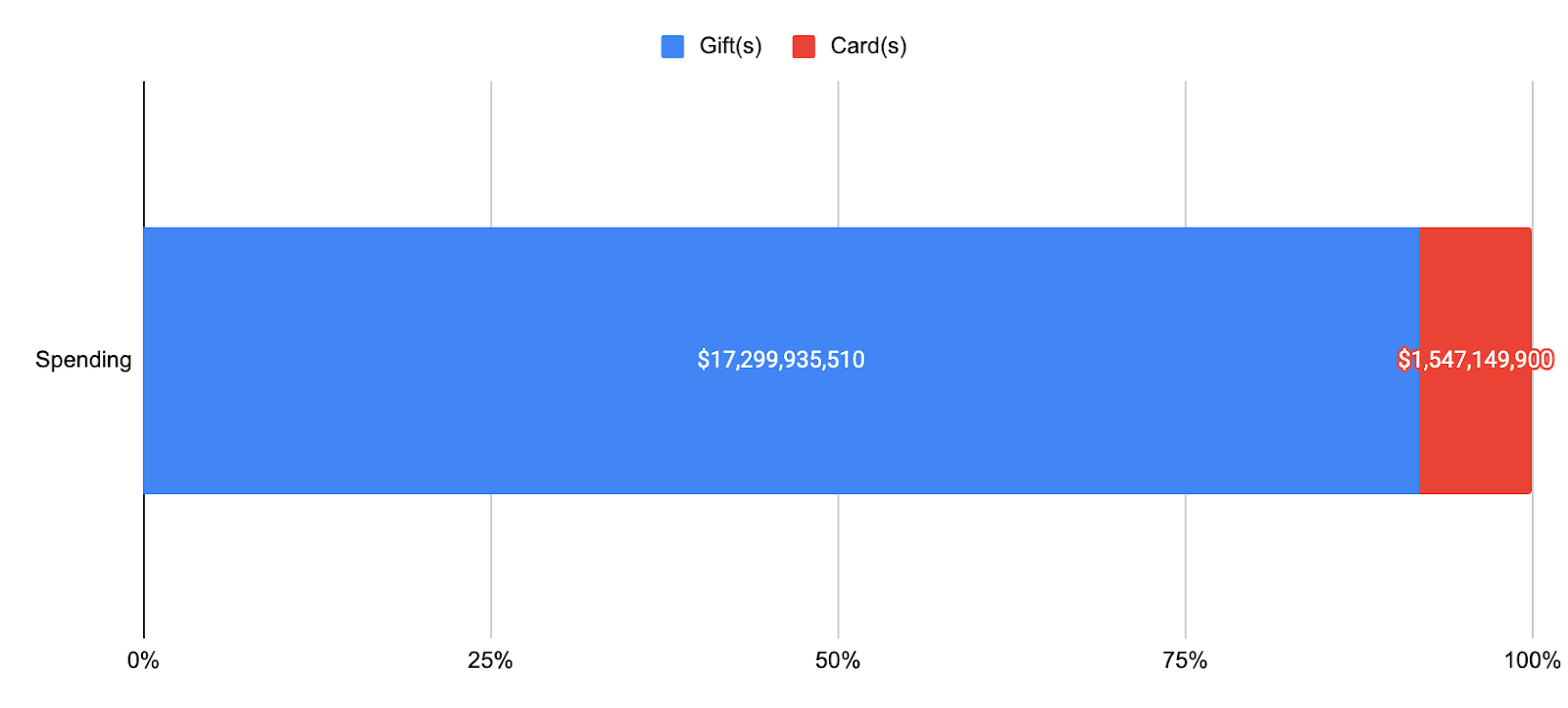
Our survey found that in 2026, spending on Valentine’s Day cards and gifts will exceed $18.8 billion, with over $1.5 billion on cards and $17.2 billion on gifts. Per person, this figure works out to an average budget of $121 for a card and gift(s).
However, between men and women, this typical spending varies drastically. Results showed that men will spend an average of $161.53 on a card and gift(s), compared with $81.73 for women.
Of the over 308 million cards and gifts bought by Americans this Valentine’s Day, more than 12 million will be sent through the USPS. 6.2 million cards and 5.8 million gifts will be sent and delivered by the USPS. However, the most common delivery method is ‘by hand’, in which partners exchange gifts in person.
National Valentine’s Day spending on gifts and cards
Results showed that many people feel pressured to buy a gift and/or card for their partner: almost one in four (23%) feel pressured to buy a card, and over a third (36%) feel pressured to buy a gift for Valentine’s Day. Men are the most likely to feel pressured to buy a gift (45%) or a card (30%) for their partner, compared with 17% and 27% of women, respectively.
Despite this pressure, over a third (35%) of people have forgotten to buy a current or former partner a Valentine’s Day card, with more than three in ten (33%) admitting they’ve forgotten to buy a current or former partner a Valentine’s Day gift.
Men were the most likely to admit they had forgotten to buy a current or former partner a Valentine's Day gift or card. Nearly two in five (38%) of men admitted they had previously forgotten to buy a gift, compared to 28% of women.
Further, analysis found that Millennial men are the most likely to admit they have forgotten to buy a partner a Valentine’s Day gift (45%) or card (50%). Overall, across generations, Millennials are the most likely to forget to buy a gift (38%) or a card (43%).
Generational response when asked if they have ever forgotten to buy their partner or a previous partner a Valentine's Day gift or card:
Not buying their partner a gift or card could be a sign of trouble in the relationship, at least for one in nine (11%), who expressed they would consider breaking up with their partner if they didn’t receive a gift or card for Valentine’s Day.
Gen-Z women (19%) are the most likely to consider breaking up with a partner if they don’t receive a gift or card for Valentine’s Day, followed by Millennial men (15%).
Generational and gender response when asked if they would consider ending their relationship if their partner didn’t get them a card or gift for Valentine's Day:
On average, men (13%) are 25% more likely to consider breaking up with their partner if they didn’t receive a gift or card for Valentine’s Day than women (10%).
That said, women are more likely than men to expect a gift or card. The majority (54%) of women said they expected a gift, compared to 44% of men. And when it comes to cards, 50% of women expect to receive a card, compared to 44% of men.
Results show that Gen-Z women are the most likely to expect receiving gifts or cards: 63% expect to receive a gift from their partner, and 53% expect to receive a card.
Generational responses when asked whether they expected to receive a gift or card:
Figures showed that one in almost one in five (19%) have regretted a card they’ve bought for their partner, and over a quarter (28%) have regretted their choice of gift. This regret was highest among men, with 24% regretting a card choice and 30% regretting a gift choice. In comparison, among women, just 14% have regretted a card and 25% a gift.
Some of this regret could be attributed to comparisons with what they see others have given and received.
Among those who indicated having regretted a gift or card, 29% said they’d compared what they’d given or received against those given and received by friends and family, while 43% have compared the gifts to those of friends and family.
However, social media also appears to contribute to the pressure. 31% of people say they’ve compared the cards they’d given or received against those they’ve seen shared by others on social media, while for gifts this “comparison” rises to 40%.
Using AI to help with Valentine’s Day plans and purchases
As the results suggest, Valentine’s Day, while still a day to express your love and affection for your partner, has quite a lot riding on it. Whether that’s an internal pressure or something felt in the relationship more generally.
With that in mind, many often search and look online for inspiration, but with the advancement and adoption of AI in people’s day-to-day searches and needs, it’s not too surprising that over a third (34%) say they have or would use AI to help them find a Valentine’s Day gift or card for their partner.
Men (42%) are more likely than women (27%) to have used or consider using AI to help source a gift or card for their partner.
Results showed that Millennial men are the most likely to have used or considered using AI to help find their Valentine’s Day card or gift, with a majority (52%) reporting they had or would use it, of whom nearly one in five (17%) said they had used it.
As a generation, Millennials are the most likely to have used or considered using AI to find their Valentine’s Day card or gift (44%), followed by Gen Z (35%).
Generational and gender response when asked if they have or would use AI to help find a Valentine’s Day gift or card:
AI isn’t just being used, or considered to be used, for finding gifts and cards. Our results show that over a third of people (36%) have used or would use AI to plan their Valentine’s Day activities, with men (43%) far more likely to turn to AI than women (28%).
As with purchases, Millennial men are the most likely to have used (16%) or considered using (37%) AI to help them plan their activities on February 14th. In all, a majority (52%) of Millennial men have considered using or have used AI to help with their Valentine’s Day activity plans.
Generational and gender response when asked if they have or would use AI to help find a Valentine’s Day gift or card:
The role of AI in relationships today
Our survey found that almost one in 10 people (9%) have turned to AI to help avoid arguments with their partner, and an additional 22% say they would consider using AI for this purpose. Suggesting that for nearly a third of adults, AI could or has been used to help avoid arguments within their relationships.
Figures showed that Millennials are the most likely to have turned to AI to avoid arguing with their partner; one in eight (12%) revealed they have already used AI for this purpose, and a further 26% said they would consider using it.
Overall, Millennial men are the most likely to have used or considered using AI to help avoid arguments with their partners. Nearly half (47%) admitted that they had used (16%) or considered using (31%) AI to help avoid arguments.
Generational and gender response when asked if they had used or would consider using AI to help avoid arguments with their partner:
A leading reason for arguments among many couples is appointments, planning, or other life admin, something our survey found nearly half (46%) of people have argued about with their partners, and an area where AI has long been found helpful.
Avoiding arguments with their partners isn’t the only reason more than one in five (22%) believe AI could help their relationship. Results showed that the most common way people felt AI could be used to help partners improve their communication (25%), helping to generate date and quality time ideas (23%), and providing a space for personal growth and self-reflection (22%).
When it comes to using AI to improve their relationships, men (30%) are twice as likely as women (14%) to see it as helpful. Millennial men are the most likely to hold this view (37%), followed by Gen-Z men (33%). In comparison, just one in five Millennial women (22%) and one in seven Gen-Z women (13%) share the same sentiment.
Generational and gender responses when asked if they believed that using AI could help their relationship:
These figures suggest that while some people believe AI could help their relationships (22%), many remain hesitant, and this hesitancy could lead to a breakup.
Figures revealed that for more than one in six (16%) people, finding out their partner had been using AI-generated advice in their relationship could lead to or has led to them ending their relationship, with this figure rising to almost one in five among Gen-Z and Millennials.
Generational and gender responses when asked whether they have ended a relationship, or would consider ending a relationship, if their partner was using AI-generated advice in their relationship:
The results from this question highlight that, for Millennial and Gen-Z men, despite being the biggest supporters of using AI to “help” their relationship, they are also the most likely to end a relationship if they learn their partner is using AI-generated advice.
When asked what the core reasons people would be against and would worry about their partner using AI to ‘help’ their relationship, results found a lack of authenticity (38%) is the leading concern, with their partner’s words and actions not feeling "real” (34%) the second most common concern, followed by privacy concerns (33%).
Methodology
Our survey, conducted on the PollFish platform, asked 1,000 US adults about their relationship status, their plans and opinions on Valentine’s Day, and their views on the use of AI platforms in relationships and how it might affect their dynamics. Results were analyzed using the satisfied sample, with respondents split 40% male and 60% female; percentages were rounded to the nearest whole number in our reporting. Responses were collated on January 30th, 2026.
Age ranges:
To estimate the number of cards and gifts sent, we analyzed Pew Research relationship forecast (which found that 69% of US adults are in a relationship). We multiplied by the latest Census Bureau data on the number of adults in the US. We then analyzed our findings against this figure to determine the number of cards, gifts, and expenditures.
The AI virtual mailbox that handles compliance for you
Get a virtual mailbox for your business and put your ongoing compliance on autopilot. All at affordable rates.

Max studied History at Northwestern and Law at the University of Michigan. He spent 4 years practicing law (M&A and insurance regulatory work) before moving to Palantir, where he led business development efforts and implementation teams at the DoD and federal civilian agencies. Max is the CEO and co-founder of Postal, a YC-backed SaaS company.
The first AI-powered virtual mailbox

![US Areas With The Most Small Businesses [Data analysis]](https://cdn.prod.website-files.com/68b848a03f7ef905bc240ff8/6a0b00ad54f3e0334bcbe034_US%20Areas%20With%20The%20Most%20Small%20Businesses.jpg)